
AI Clubhouse Engineering Deep Dive #1
16 may 2026
first engineering deep dive. the cellar of beverly hills. four talks. zero tests written. not a single figma opened. one potential acquirer mentioned mid-demo. the bar is going up.
Overview
- Turnout: Smaller by design: the format called for a room where questions could go deep
- Location: The Cellar of Beverly Hills, hosted by Duránd and Maya Davis
- Organizers: JM + Robin, with thanks to here.now for sponsoring
- Demos: 4 talks. A 14-year engineering vet who restructured his entire company around Claude Code. A side project built to avoid building a different side project. A Snapchat engineer with six AI accounts and an overnight agent loop. A security platform that, in its builder's own words, has "too much security."
- Vibe check: If the main meetups are about who's building with AI, the engineering deep dives are about how: the stack, the decisions, the things that shipped and the things that broke
The Crowd
- Engineers, founders, and operators. The kind of people who showed up with specific problems and left with half a CLAUDE.md drafted on their phone
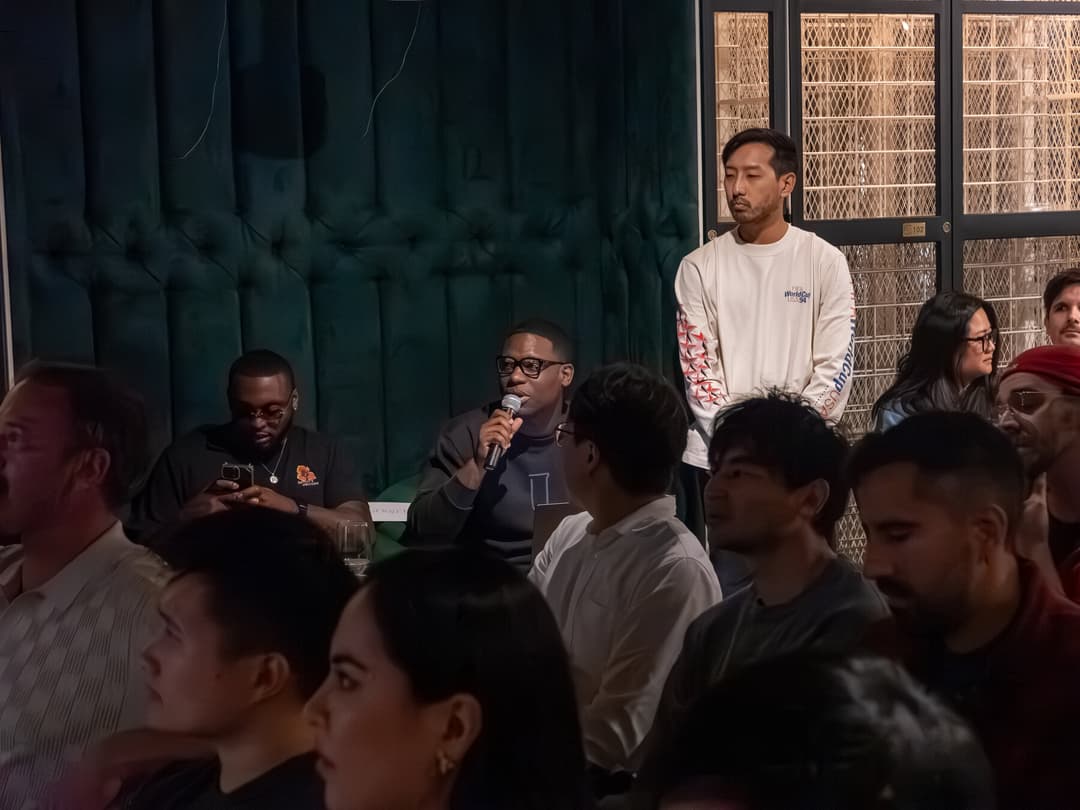
- Smaller room than the main meetups, which was the point. Dennis's talk ran into a full architecture conversation that had to be cut off before the next speaker. Thomas got questions about sandboxing that went three levels deep
Welcome
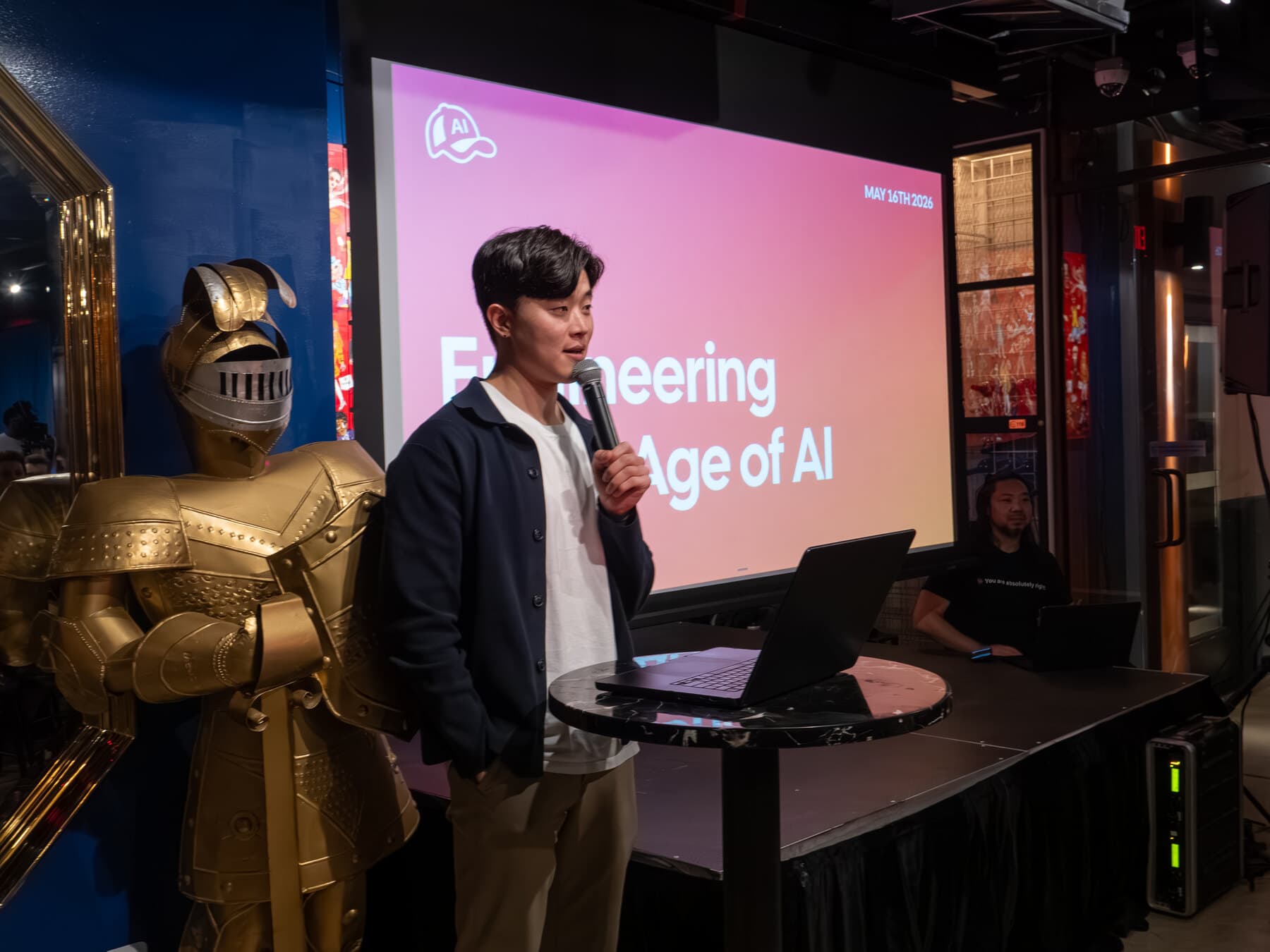
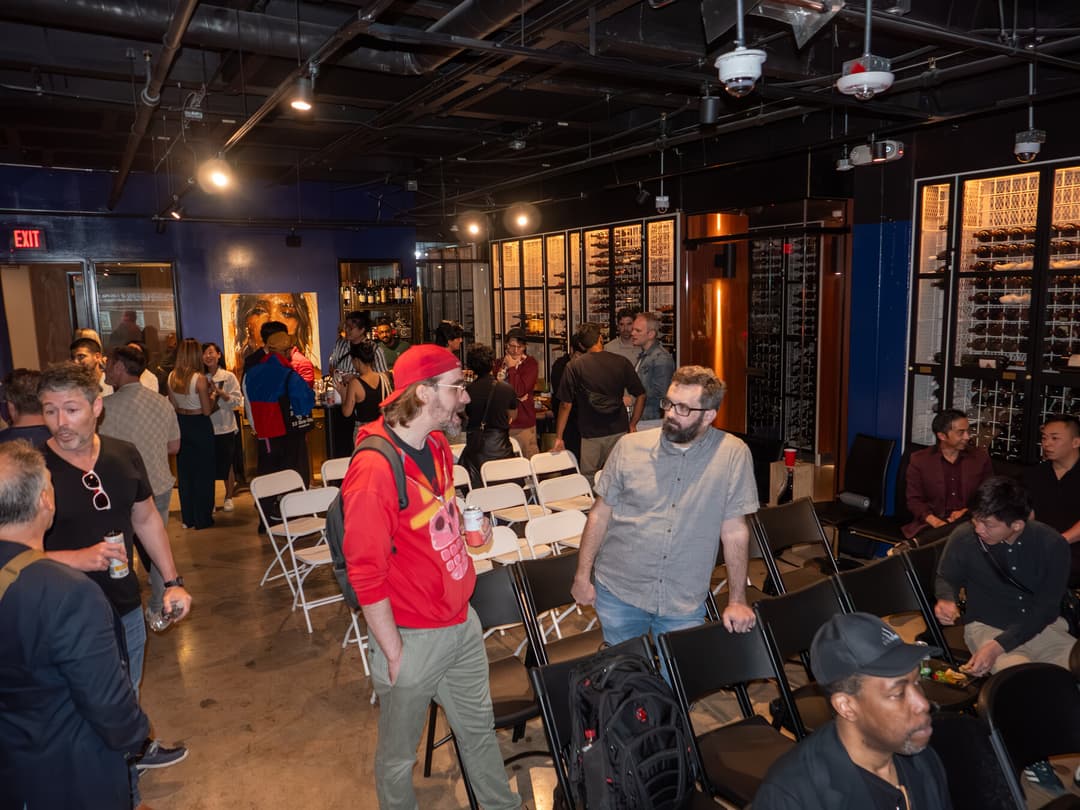
- Duránd and Maya Davis opened the night at The Cellar: Beverly Hills, private wine room, velvet couches, one gold suit of armor standing at attention next to the podium for the entire event
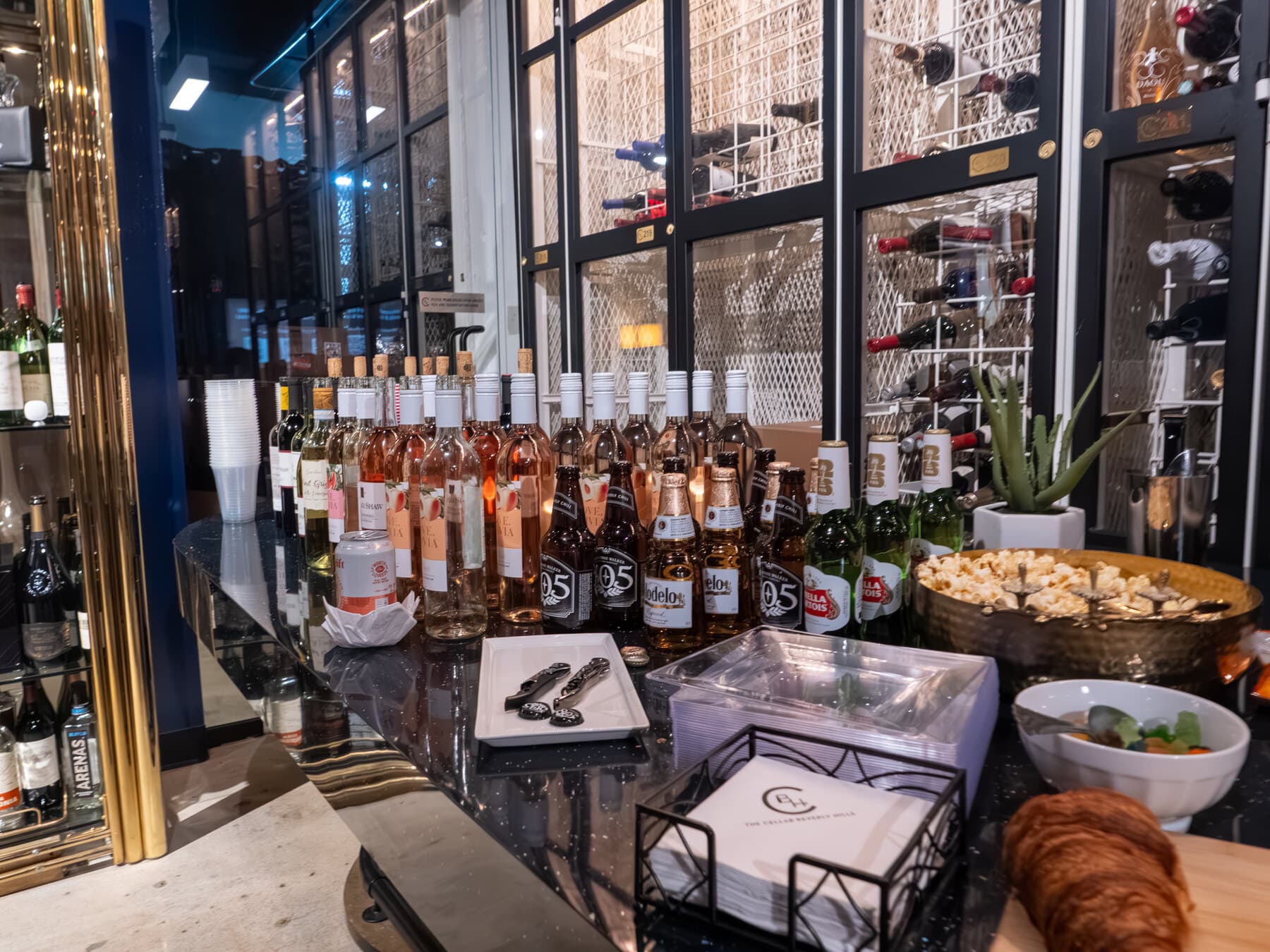
- Maya, on the venue choice: "I was told by JM and Robin that this is not a drinking crowd. And it's unfortunate that's true because we are in a wine cellar."
- here.now on the sponsor list. Adam's instant-URL tool keeps showing up at these events because agents keep needing somewhere to put things
Demo Highlights
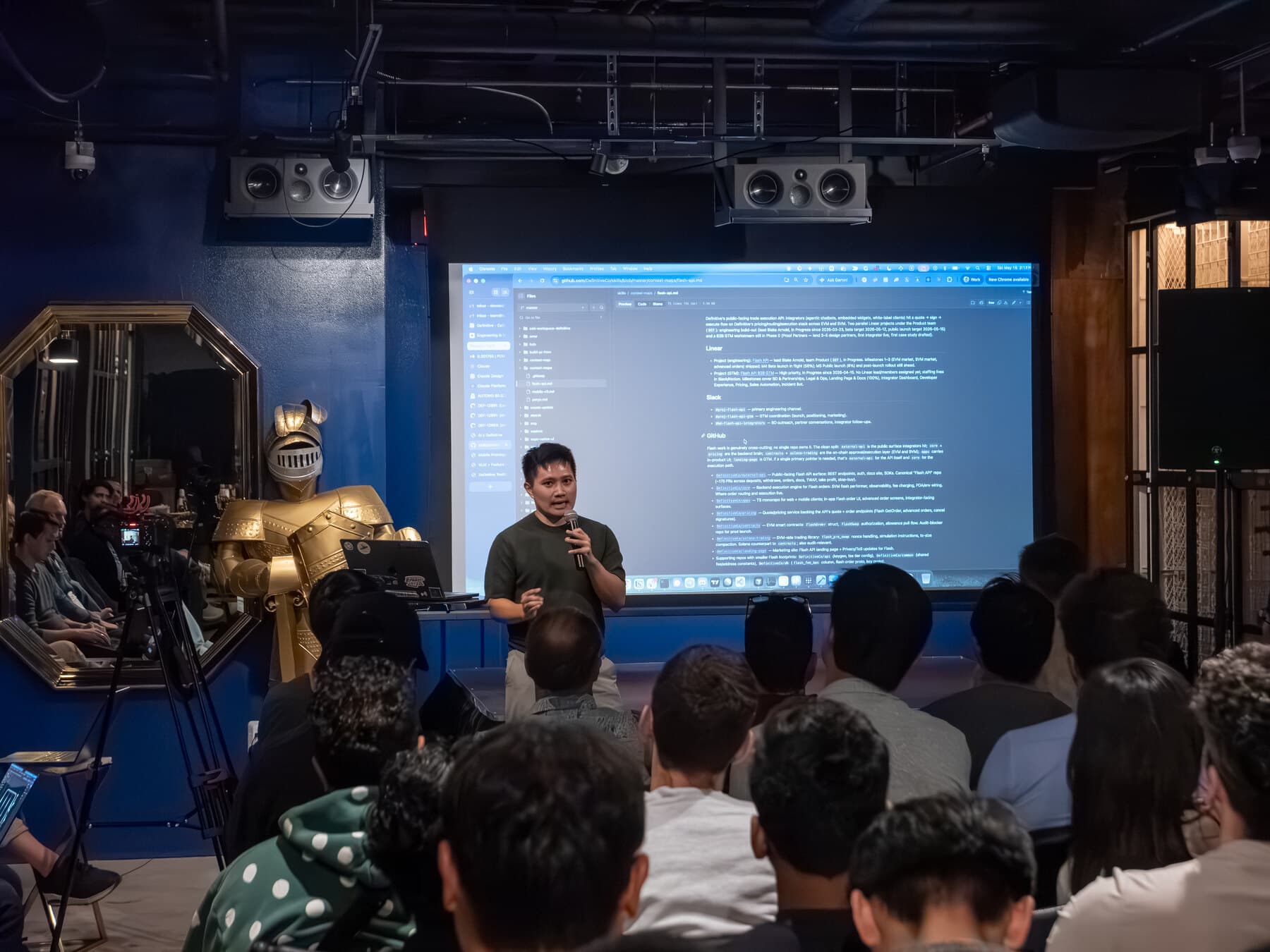
1. Dennis: The Lunch-Break Architect
Watch full demo- CTO of Definitive, a crypto trading platform. 14 years in engineering. Has spent the last four months rebuilding how a 15-person company works, top to bottom, around Claude Code
- First metric: a mobile app doing billions in trading volume, shipped in 2.5 months with 3 engineers. Traditional estimate: 10 engineers, 6 months
- Second metric: "The entire AI spend for my company of 15 engineers and six non-technical folks is about 4K a month. So for the cost of 25% of another engineer, we're able to 2x to 3x the output of the company."
- His dad had a 6-hour layover in LA. Dennis drove out for lunch. Shipped a feature to production in 12 active minutes before he left. "I guess I can do that now because we're AI-enabled."
- The org model: teams of 3 (one product, one full-stack, one rotating designer). A 4-step pipeline handles every feature: idea to spec, spec to clarifying questions, questions to codebase estimate, estimate to build. Claude runs the spec
- The line that drew the loudest reaction: "We basically stopped writing tests. And I actively tell my engineers: please don't write tests." His argument: tests existed to protect your code from the next engineer. When the next entity reading your whole codebase has a 1M-token context window, the correctness is implicit
- A non-technical marketing person shipped a full leaderboard feature end to end without touching engineering
- Their internal OpenClaw MCP agent is named Vodachi (described, with affection, as "a shirtless Italian guy") and resolves production incidents in about 30 seconds
- He has a second talk he wants to give on AI org disruption: the anxiety of moving faster than your team knows how to move. Worth booking
2. Andrew: The Figma Abstainer
Watch full demo- Data science background, now a PM; also building Curated, a crypto fund, on the side
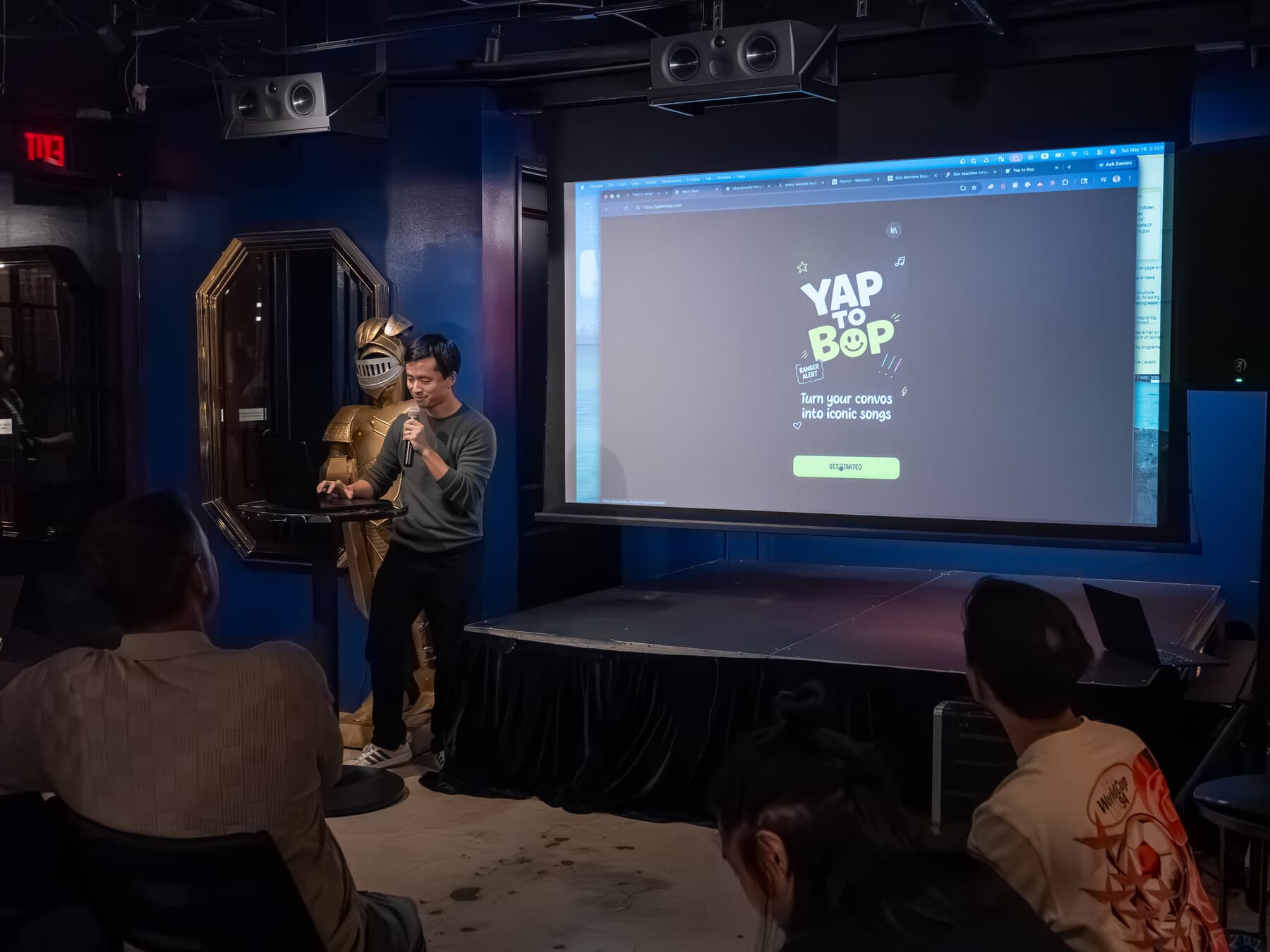
- Built Yaptabok because he didn't want to work on what he was supposed to be working on. "I built this because I wanted to build a map. Why not? The only problem is I've been doing a lot of random side projects."
- What Yaptabok does: screenshot a text conversation, the app OCRs it, Suno generates a song from the text, you get a shareable link. Slot machine UI to pick mood, genre, and vocals
- Live demo: fed in a screenshot of "Sam Altman texting Nurim Morati." Song played. Room laughed. He offered to DJ the after-party
- The actual talk was about design differentiation: how to make AI-built products not look AI-built. Workflow: use ChatGPT's image generation to iterate on brand guidelines until they stop looking generic, extract transparent assets, build a custom layout editor instead of prompting Claude to move things pixel by pixel
- "Welcome to design. We're at Codex 5.5. I'm asking the most advanced AI model to move this icon three pixels to the left and turn it maybe 20 degrees."
- On Figma: "I open Figma never. I never opened Figma."
- On Cursor, who gave him $10K in credits: "Don't let them buy you out. It's still kind of a very mediocre product at the current moment. It breaks all the time. I'm moving back to Conductor after this talk."
3. Jeffrey Tchan: The 24-Hour Employer
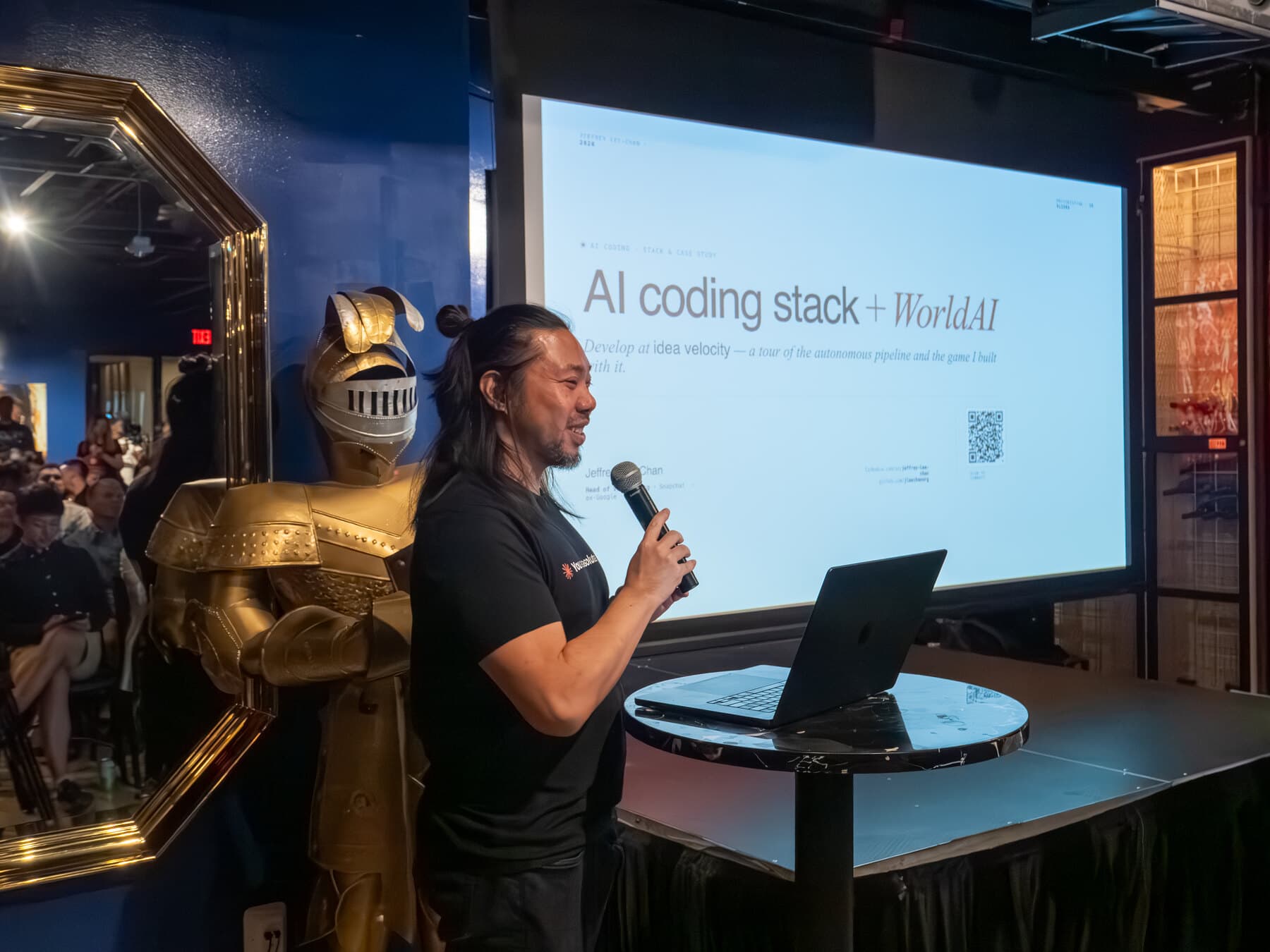
Watch full demo- Head of [Engineering / AI] at Snapchat. Building two things after hours: Hermes, a personal AI orchestration system, and worldarchitect.ai, a D&D campaign simulator he's been playing solo for hundreds of hours
- Hermes is a terminal orchestration layer built on a forked tmux — runs Claude Code, Codex, and Gemini in parallel, sends notifications, loops overnight. The operating philosophy: "Imagine you hired an engineer for 24 hours, and you only give them work for 8 hours a day. You'd be like, oh my god, I'm wasting my money. Same thing here — you want to run them overnight."
- He runs six separate AI accounts to stay off rate limits. This is presented matter-of-factly
- His slide deck opened with a pyramid diagram that said "OpenClaw" on it. He spotted it immediately: "It says OpenClaw but actually I don't believe in OpenClaw anymore. It's Hermes. That was a bit of a mistake."
- On running Hermes on his Snapchat work laptop, when asked: "Hermes is not approved or banned. But I'm just using it. Don't fault me."
- worldarchitect.ai: 12 autonomous factions, time-based world events, social HP (his invention to stop "give me your kingdom" exploits), hash-verified dice rolls so the LLM can't narrative-cheat, 300K token context, God Mode where you can rewrite the rules or become a multiverse god
- "I spent like hundreds of hours playing my own game. I'm going to do an alpha launch, but I actually can't play normal RPGs anymore. Like I'm trying, but then I get bored."
4. Thomas: The Too-Much-Security Engineer
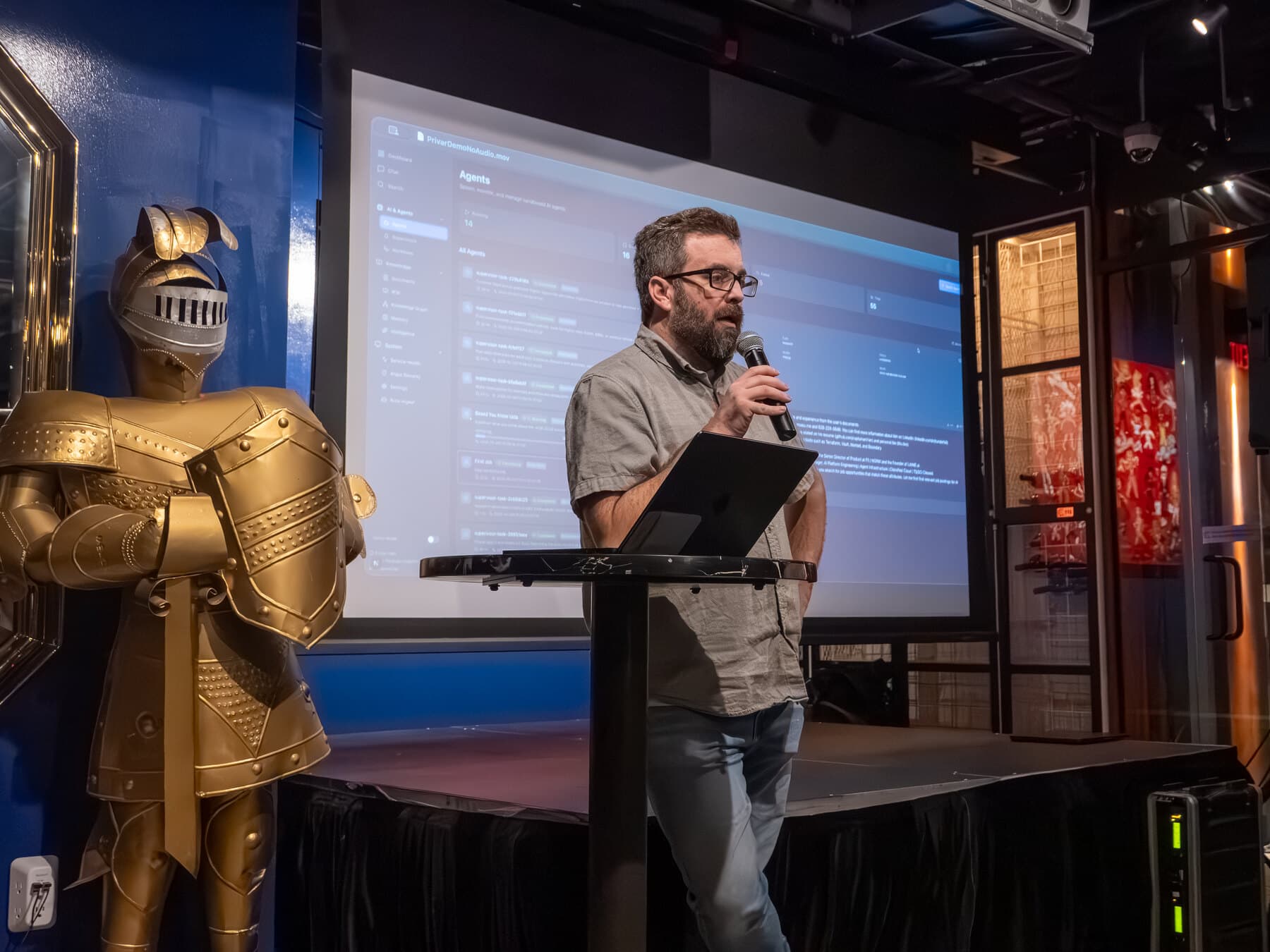
Watch full demo- Solo builder; background at HashiCorp and PayPal fraud (2008). GitHub: Captain Archer
- Built PreVar, a private intelligence platform for the industries where sending data to Claude's API is not a preference question but a legal impossibility: healthcare, finance, government, DoD
- The architecture: OpenBao (the CNCF fork of HashiCorp Vault) for credential management, Apple Keychain for unsealing, ephemeral credentials per agent session, sandboxed execution environments, and a graph neural network-based behavioral anomaly detector called Argus that flags when an agent starts acting outside its normal pattern
- He fine-tuned a Mistral 7B model on Secure Controls Framework compliance data and open-sourced it on Hugging Face. The 120B version is next
- The designed failure mode: if a security control fails, the system fails hard. No graceful degradation to a less-secure state. "I've had some issues with too much security."
- Also built a voice agent that makes doctor's appointments for him. Falls back to text-to-audio if the call fails. This was a bonus detail
- Mid-demo, someone asked about his prompt injection defenses. His answer: "I'm in some discussions with a potential acquirer, so I can't share them at this moment." The room took a second to process that. He did not elaborate
- Public alpha coming soon. GitHub: Captain Archer
Takeaways / Common Themes
1. The org structure is the real leverage, not the model.
Dennis made this explicit: switching between Claude Opus and Codex gives you roughly 1.1x–1.2x. Rebuilding how your team writes specs, reviews PRs, and runs agents gives you 2x–3x. The bottleneck shifted from "what can the model do" to "how do we organize around it." Andrew's "I never open Figma" runs the same logic from a different angle: the tool matters less than the workflow built around it.
2. Not writing tests is now a principled position, not a shortcut.
Dennis said it plainly and the room pushed back. His argument: tests were a contract between you and the next engineer. When the next entity reading your codebase has a million-token context window and generates fewer bugs than most humans, that contract changes. You can disagree, but he'd shipped a lot to production in the previous four months and the numbers were hard to argue with.
3. Fixed AI costs are a shift schedule, not an expense.
Jeffrey runs agents overnight on monthly subscriptions he'd be wasting if he stopped at 5pm. It's a different mental model from "use AI when you're stuck." His Hermes pipeline runs while he sleeps, and worldarchitect.ai's world keeps ticking between his sessions. The people getting the most out of these tools aren't treating them as on-demand utilities.
4. The regulated-industry gap is enormous and basically unsolved.
Thomas built PreVar because healthcare, finance, and government clients cannot send data to Anthropic's API at all. Not "prefer not to." Cannot. That's a large share of the economy with near-zero access to the tooling everyone in that room uses daily. The person who solves this with real security architecture (not a compliance checkbox) has a very large market, and Thomas is further along than most.
5. Side projects are a new kind of proof of work.
Andrew built Yaptabok to avoid a different project. Jeffrey built a D&D game he's played solo for hundreds of hours. Neither was optimizing for TAM or investors. Both are technically sophisticated, shareable, and honest about what they are. The bar for "I can build" has changed, and the new bar is showing the thing you built when nobody asked you to.
After the Event
- Chairs got moved. Duránd and Maya offered a tour of the wine cellar and the cigar lounge. People took them up on it
- Dennis had a circle around him until close to 8pm. The architecture conversation that got cut off during Q&A picked up again standing near the door
- Next up: back to the full format at the end of the month. Bigger room, more demos, the general AI Clubhouse crowd. Look for it on the Luma calendar
Shoutouts
- here.now and Duránd and Maya Davis (The Cellar of Beverly Hills): the venue, the wine nobody drank, and the gold knight
- Dennis, Andrew, Jeffrey, and Thomas: every talk had the room leaning in
- Thomas: "I'm in discussions with a potential acquirer" is not a standard mid-demo disclosure. Respect for the transparency
- Jeffrey: running Hermes on a work laptop, six AI accounts, overnight loops. The legal situation is unclear. We are not asking
- Everybody who showed up on a Saturday to argue about test coverage instead of enjoying a Beverly Hills wine cellar the normal way
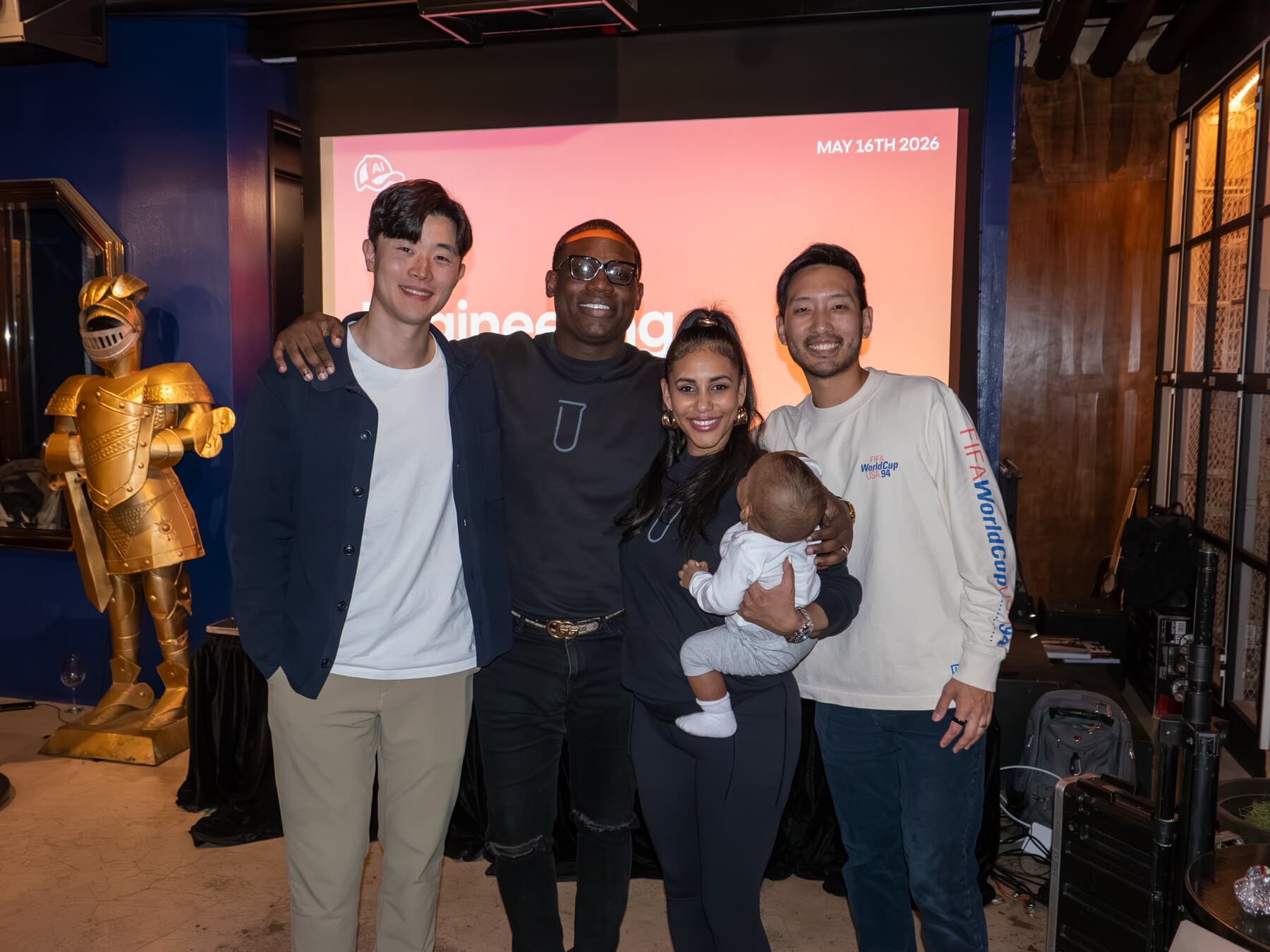
- The gold suit of armor: present for all four talks. Said nothing. Stole every photo
P.S. A reminder, since you probably feel like everyone's already figured this out except you: OpenClaw is about six months old. The transformer-driven AI consumer revolution is two or three years old at most. Dennis said his entire engineering mental model changed in the last four months. Jeffrey is running agents overnight on a Snapchat laptop. Thomas is fine-tuning compliance models in his spare time. Everyone is figuring this out in real time. We're doing it together, in the same room, and that's the whole point.
Join the community and stay updated on upcoming events:
Subscribe for future talks, demos, and community meetups. Interested in sponsoring? Email hello@aiclubhouse.com.
See you at Engineering Deep Dive #2.
JM & Robin